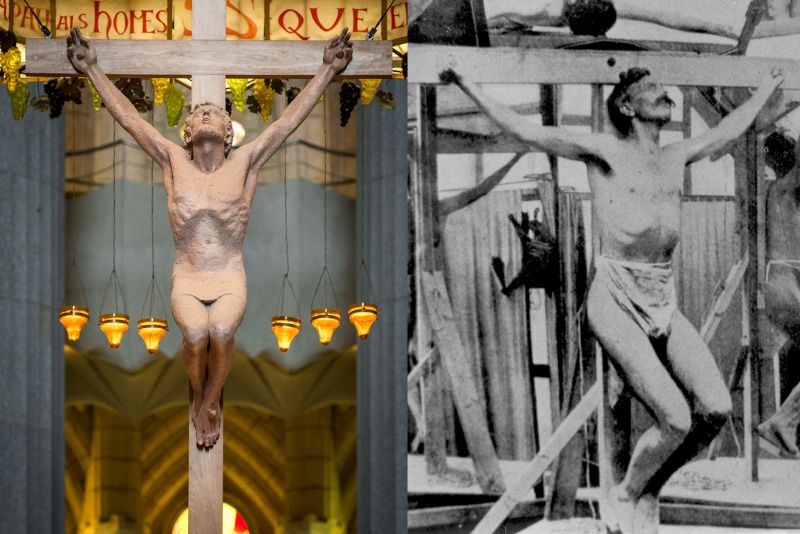
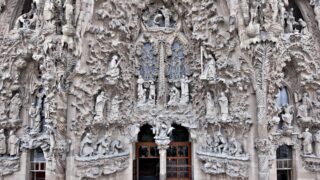
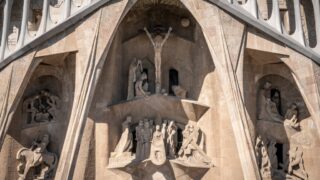
When Antoni Gaudí was working on the Nativity façade, he had figures sculpted using real people and animals as models to unify them and make them as life-like as possible. He chose people close to hand, such as collaborators from the worksite, worshippers, children from the school and residents of the El Poblet neighbourhood, from which today’s Sagrada Família neighbourhood emerged, and tried to find some connection to the character they would represent. One of them was Mariano Barceló, a stonemason at the Sagrada Família who posed for Christ on the crucifix, as we can see in the picture below from the Temple museum:
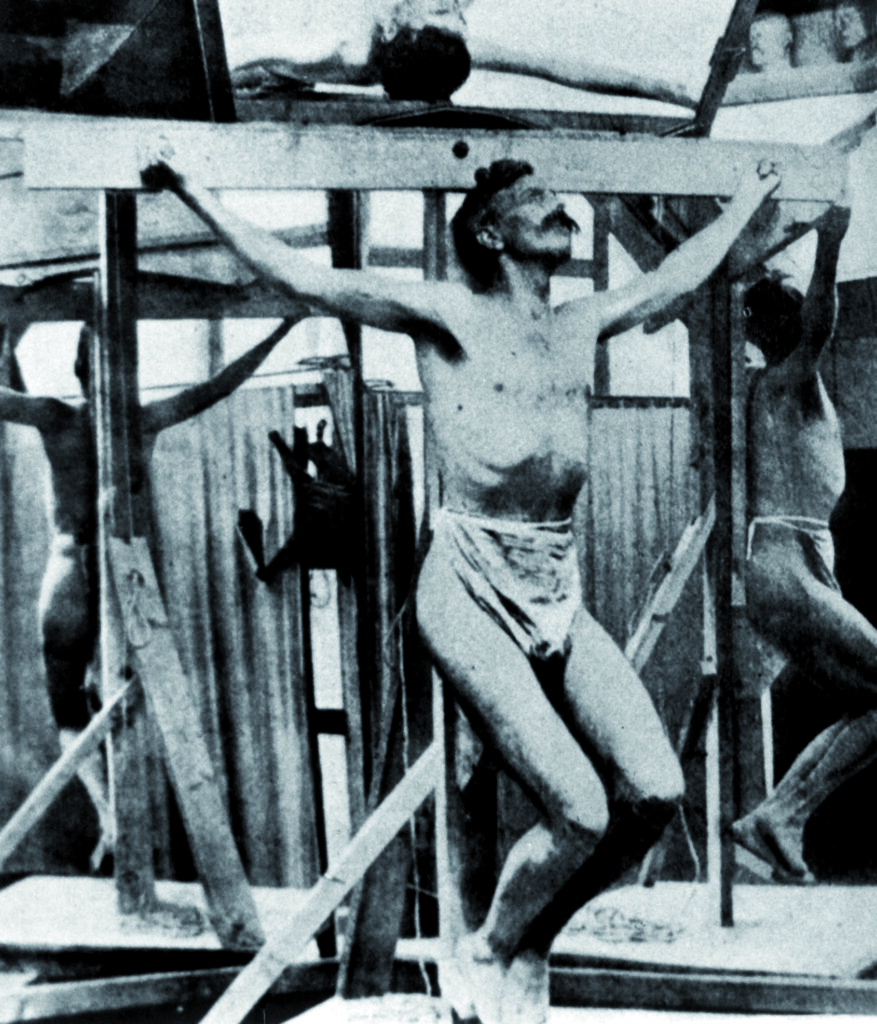
Mariano Barceló posing for the crucifix in Antoni Gaudí’s workshop
The photo, which doesn’t give the model’s name, is from an article published in the Catalan journal Gaseta de les Arts on 1 july 1926, just after Gaudí’s death, which explained the plaster moulding technique the architect used for the sculptures and included pictures of his workshop.
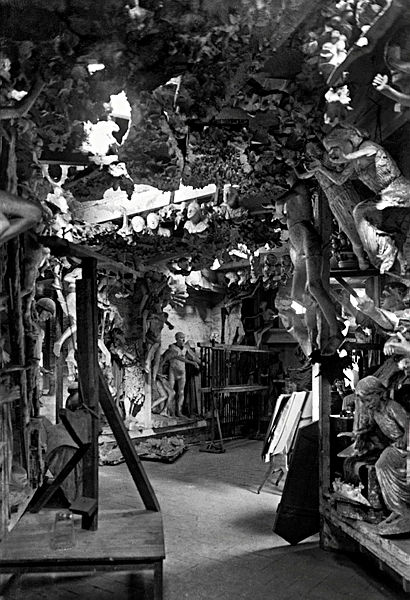
Plaster moulding technique: using knowledge from anatomy classrooms at the hospital, the architect made wire skeletons and covered them with a mouldable metal mesh. Once he found the right position and appearance, he looked for the right model and photographed them in front of mirrors to get several perspectives. Then, the model was covered in a layer of plaster, which hardened after a few minutes and created a scale mould to be replicated in stone.
One of Gaudí’s collaborators, sculptor Carles Mani, used this model of the Christ to make the crucifix for the chapel of prayer at Casa Batlló, which is now in the crypt at the Sagrada Família, and in 2010 it inspired artist Francesc Fajula in creating the Christ of the baldachin for the Basilica’s main altar.
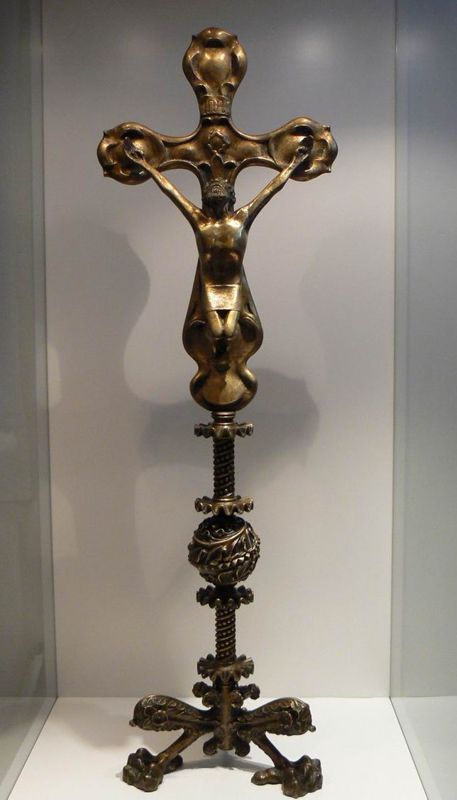
Crucifix that Carles Mani made in 1906
Mariano Barceló’s descendants have always been very aware of his ties to the Sagrada Família, through family stories and the photo published in Gaseta de les Arts. And to this day, no documents have been found showing he was used as a model or was employed by the Temple.
Recently, however, Mariano’s obituary was found in the December 1926 issue of El Propagador de la Devoción a San José, a publication founded by the promoters of the Sagrada Família. This text explicitly connects him to the photo published in Gaseta de les Arts. It is a tribute to his contribution to the Temple:
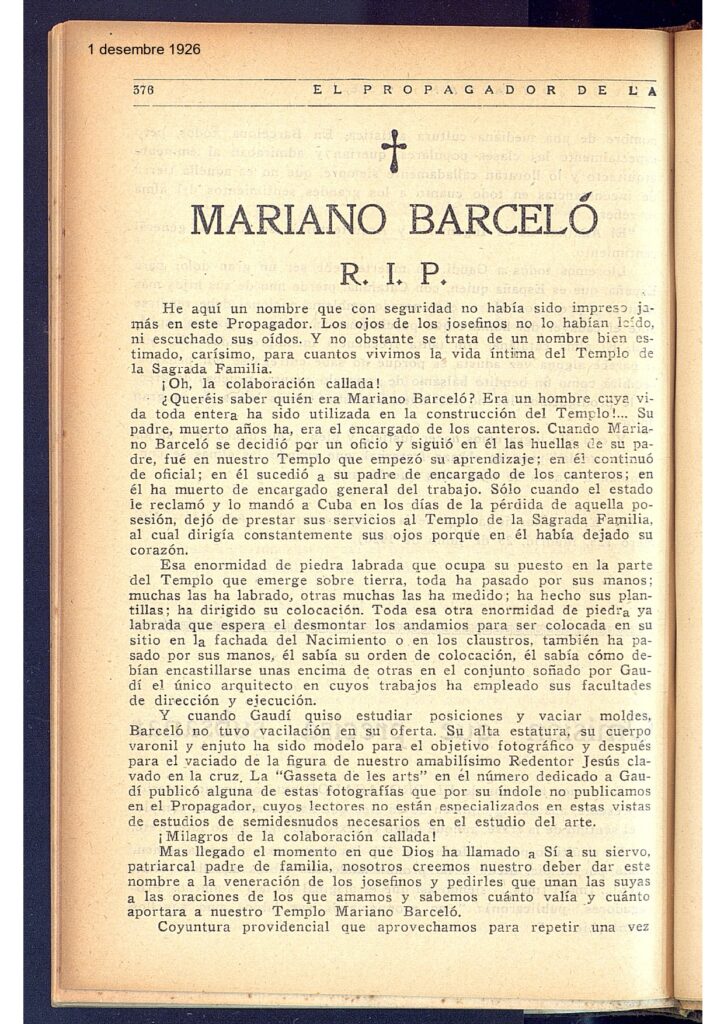
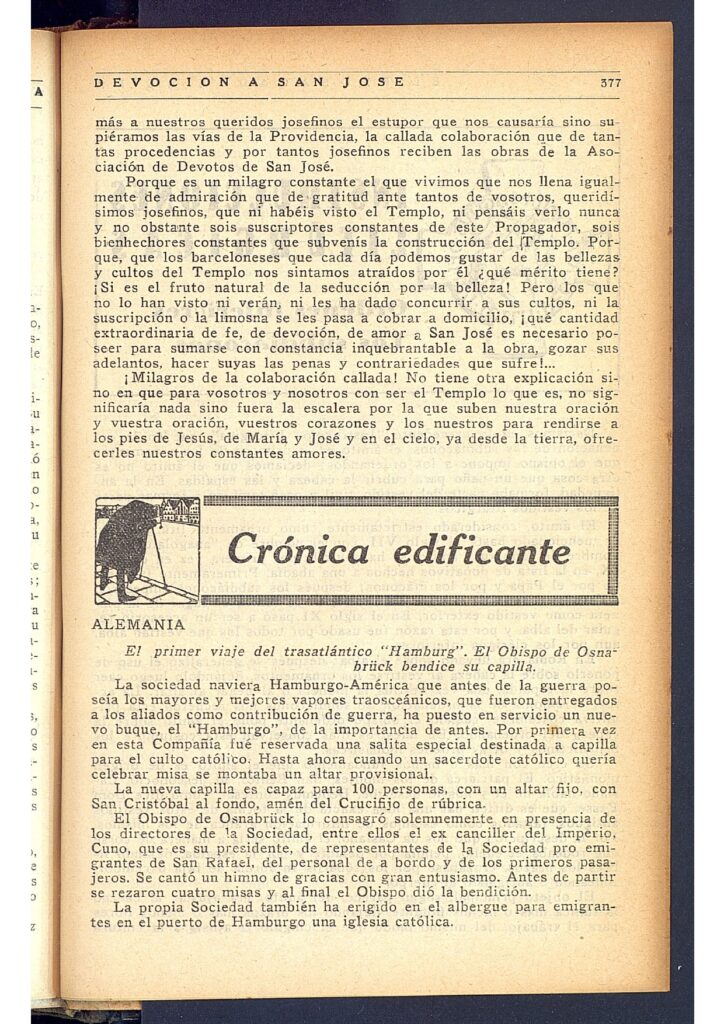
Montserrat (Mariano Barceló's granddaughter): «We were very excited about this article because it is a tribute to him and his work»
To learn more about Mariano Barceló’s story, we spoke with his granddaughters, sisters Anna Maria and Montserrat, and great-granddaughter Carla, who is collaborating with the Sagrada Família.
What do you know about Mariano?
Carla Planas (C.): My grandmother, who lived in the neighbourhood and had deep ties to the Sagrada Família, told us the story of her father-in-law Mariano. I’m an art historian and I love researching. While I was making our family tree, I found out that my great-grandfather was born in Tarragona. Laia (head of the Junta Constructora Documentation Centre and archive) told me that many of Gaudí’s collaborators were from Camp de Tarragona, as the architect was. These included his father, Antonio, who according to the recently uncovered obituary was also in charge of the stonemasons workshop at the Sagrada Família, and it may have been the architect himself who invited him to come work in Barcelona. That is how Mariano, his son, came to train at the Sagrada Família and, later, inherit his father’s position when he died.
Anna Maria Barceló (A.): What we know is that the whole family moved from Tarragona to Barcelona, to Carrer de Jovellanos, and then moved to Carrer de València, between Carrer de Sardenya and Carrer de la Marina, to be closer to the Temple.
What did he do at the Temple?
Montserrat Barceló (M.): We’ve always been told that he was the head stonemason, that he made the turtles on the Nativity façade and was the model for the crucifix, which my father said was originally meant to go on the Passion façade.
The article El Propagador explains more about him and shows he was the model for the Christ. What has this discovery meant to you?
(M.): Mariano has always been part of our lives through our parents’ stories. We were very excited about this article because, for the first time, what had always been a family story was publicly documented and recognised. It is a tribute to him and his work, and also recognition for our mother, who spoke of our grandfather with great devotion and wished everyone could know his story.
(C.): Laia told me that all the information about the workers went up in flames during the war, so I never expected to find an article like this. Seeing how they recognised the type of person he was and his devotion to his work, in such detail, was very moving. Professionally, I love working with this type of documents, which enrich oral sources and help build the history of the Temple.
«Sólo cuando el estado le reclamó y lo mandó a Cuba en los días de la pérdida de aquella posesión, dejó de prestar sus servicios al Templo de la Sagrada Familia, al cual dirigía constantemente sus ojos porque en él había dejado su corazón»
Excerpt from Mariano Barceló’s obituary in El Propagador de la Devoción a San José. 1 December 1926. Page 376
And now what do you feel when you see him in the sculpture on the Basilica altar?
(M.): It’s very moving and it’s an honour. We’re very proud and thankful to be here today at the Sagrada Família speaking with you.
It also recognises someone from the neighbourhood. Do you remember El Poblet?
(A.): We lived there for many years and it has changed a lot. We all used to know each other. It was like a village. I remember where we all used to wash our clothes and even the dairy shop that sold milk from a farm on Carrer de la Marina.
And what does the Sagrada Família mean to you?
(M.): It’s part of our history, because of the family ties but also because it’s where we’ve lived. You could say we’ve grown up with the Sagrada Família.
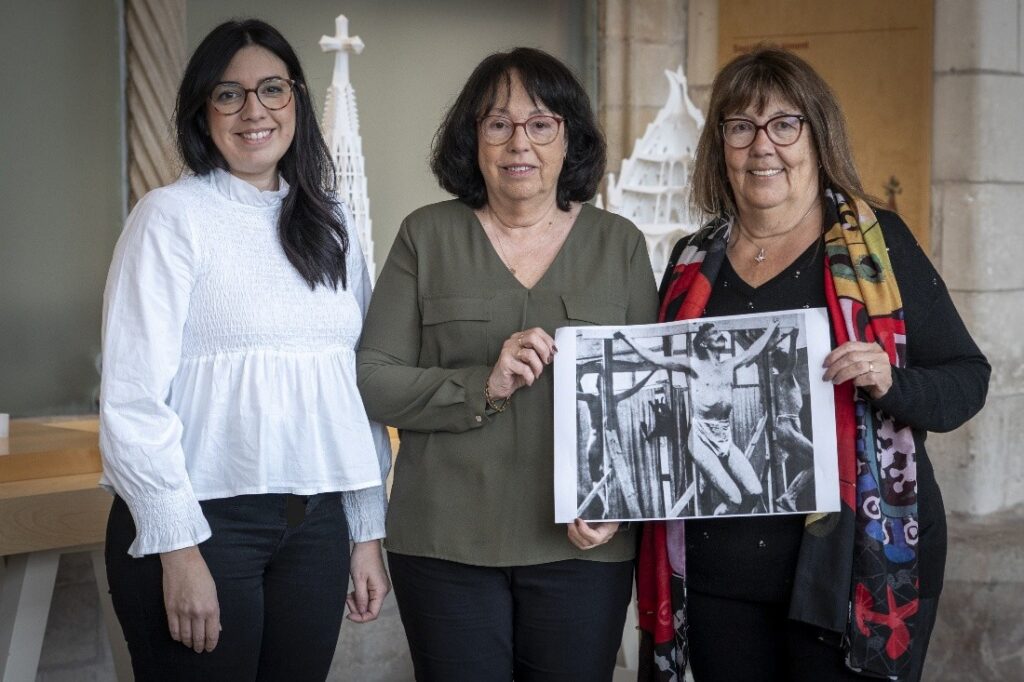
Carla Planas, Montserrat and Anna Maria Barceló: great-granddaughter and granddaughters of Mariano Barceló Roca
1 comment
Catherine Combier-Donovan
Quelle église extraordinaire ! Les vitraux sont magnifiques ainsi que le site tout entier. Merci pour ce site-web qui me fait revivre cette belle visite!